
WELCOME BONUS 300%
UP TO €2000 + 100
FREE SPINS
UP TO €2000 + 100
FREE SPINS
Home → Blackjack
Blackjack at Casino-Robocat: Variants, Rules and Payouts
What doesn't count as Blackjack after Split?
Blackjack Split, as defined by rules such as Resplit Aces and Double After Split, can significantly alter the game's dynamics. Resplit Aces, for instance, improves the RTP by approximately 0.08 percentage points, a valuable adjustment for players seeking better returns. However, this rule does not permit a standard Blackjack payout on hands formed after a split.
The game mechanics clarify that a Blackjack on a split hand, even if it totals 21, is typically treated as a regular win of 1:1, not the superior 3:2 payout. This distinction is crucial for players understanding the potential outcomes of split hands, particularly when Aces are involved. The base strategy guidance for Blackjack 6 Decks emphasizes these specific payout structures.
Understanding these nuances is key for beginners to navigate the rules of Blackjack at Casino Robocat. While Double After Split offers a 0.14 percentage point RTP improvement, the payout for a natural Blackjack on a subsequent split hand remains at 1:1. This means a player achieving a 21 on a split hand will receive even money, not the higher 3:2 ratio.
Bonus Lost Due to 10 Percent Contribution
The welcome bonus at Casino Robocat offers 300% up to €2,000 plus 100 free spins, but its utility is significantly impacted by game contribution rates. Table games, including Blackjack, only contribute 10% towards the wagering requirements. This means for every €10 wagered on Blackjack, only €1 counts towards clearing the bonus.
A substantial wagering requirement, often around 40 times the bonus amount, becomes considerably more challenging to meet with this limited contribution. For example, clearing a €100 bonus would necessitate €4,000 in turnover from slots (100% contribution), but would require €40,000 in turnover from Blackjack (10% contribution).
Consequently, players opting to play Blackjack or other table games for bonus wagering may find themselves unable to fulfill the terms within a reasonable timeframe. The 100 free spins, likely tied to slot games, offer a more direct path to potential winnings, bypassing the restrictive contribution of table games.
Continuous Shuffling Machine shuffles after each round
The implementation of a Continuous Shuffling Machine (CSM) in some Blackjack variants at Casino Robocat means the shoe is shuffled after every hand. This technology ensures a constant flow of cards, eliminating the advantage of card counting. Games utilizing a CSM effectively reset the deck's composition after each player's turn.
While CSMs enhance game speed and fairness by preventing card counting strategies, they are often associated with standard rule sets. For instance, Blackjack 6 Decks with standard rules and a 3:2 payout has a house edge of 0.46%. The CSM itself does not inherently increase the house edge, but negates player-side card counting advantages.
For beginners, playing against a CSM simplifies the game by removing the complexity of deck penetration and card counting. This allows a focus on mastering basic strategy, which is essential for achieving the optimal RTP of 99.54% in games like Blackjack 6 Decks. The rapid shuffling ensures a consistent game pace.
Error insurance: 7 percent additional house edge
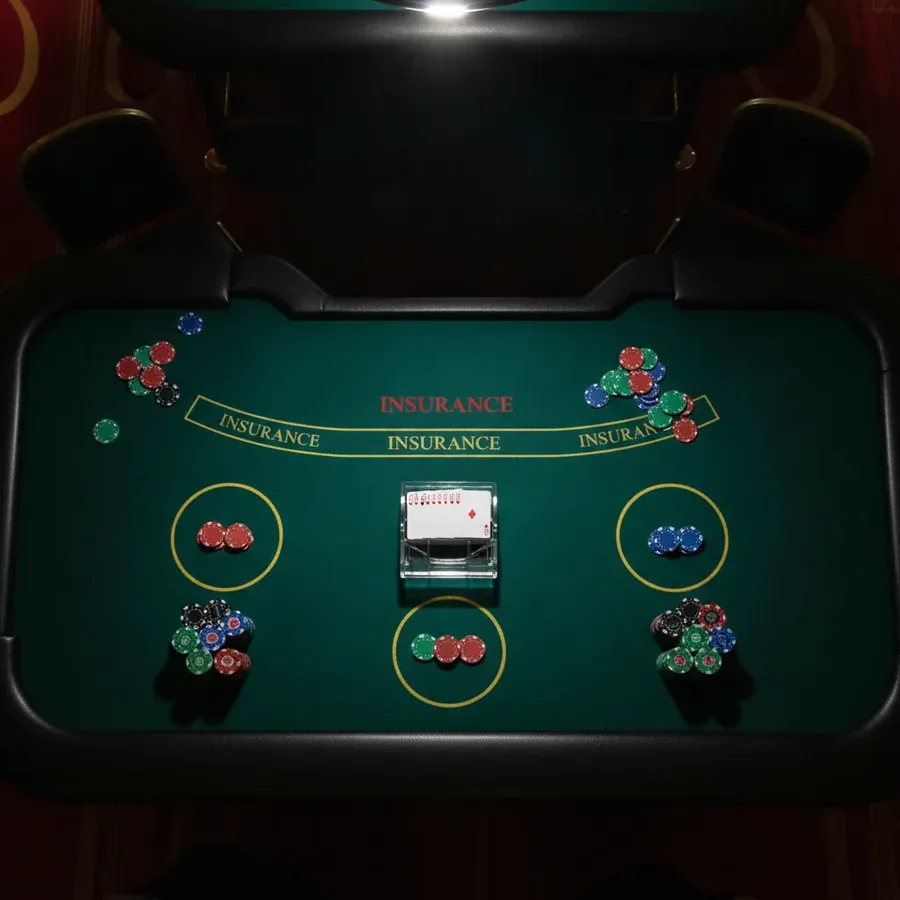
Blackjack Insurance, offered when the dealer shows an Ace, functions as a side bet with a significant drawback. This wager pays 2:1 but carries an exceptionally high house advantage. For 6-8 deck games, the RTP for Insurance is a mere 92.53%, resulting in a substantial 7.47% house edge.
The optimal strategy for card counters suggests taking Insurance only when the True Count is +3 or higher, a scenario rarely encountered by casual players. For beginners, the advice is unequivocal: always decline this side bet. The Insurance bet significantly erodes the overall RTP of the main Blackjack game.
Accepting Blackjack Insurance, even for a 2:1 payout, drastically increases the casino's advantage. Over time, this side bet is a guaranteed path to losing money faster than playing the core game. Players should focus on the main game's RTP, which can be as high as 99.54% for Blackjack 6 Decks, rather than a losing proposition like insurance.
What a Natural Blackjack Practically Pays Out
A natural Blackjack, achieved with the first two cards totaling 21, is the most desirable outcome in the game and typically pays out at a superior rate. For standard Blackjack variants at Casino Robocat, such as Blackjack 6 Decks, this payout is set at 3:2.
This means for every €10 wagered, a natural Blackjack results in a €15 win, a significant advantage over the standard 1:1 payout for other winning hands. Games with a 6:5 payout for Blackjack, like the specific variant listed, drastically reduce this to €12 for a €10 bet, increasing the house edge by 1.39 percentage points.
Blackjack Liberal Vegas Strip exemplifies favourable rules with a 3:2 payout for a natural Blackjack, alongside other player-friendly conditions like S17, DAS, and Late Surrender, contributing to an RTP of 99.72%. Beginners should always prioritize tables offering the 3:2 payout to maximize potential returns on a natural Blackjack.
Blackjack variants at a glance
| Variant | Payout | House edge | Rule | Bet range |
|---|---|---|---|---|
| Blackjack Insurance / Versicherung (6–8 Decks) | 92.53% | 7.47% | Separate Nebenwette bis 50% der Hauptwette, wenn der Dealer ein Ass hat. Basisstrategie schreibt IMMER Ablehnung vor (außer Karten zählen bei True Count ≥ +3). Bei einem Deck Vorteil ≈ 5.88% | Insurance 2:1 |
| Blackjack Liberal Vegas Strip (liberale Regeln, 3:2) | 99.72% | 0.28% | Günstigste Regelkombination: S17 + DAS + Resplit + Late Surrender. Standardabweichung 1,15 | Blackjack 3:2, Gewinn 1:1 |
| Blackjack Split / Double / H17 – Regel-Effekte | n.a. (Regel-Modifikatoren) | H17 +0.22 Prozentpunkte; RSA −0.08 Prozentpunkte; DAS −0.14 Prozentpunkte | Dealer Hits Soft 17 verschlechtert RTP um 0.22 Prozentpunkte; Resplit Aces verbessert um 0.08 Prozentpunkte; Double After Split verbessert um ca. 0.14 Prozentpunkte; 6 Decks statt 8 – ca. 0.02 Prozentpunkte. | Double – Einsatz ×2 mit einer Karte; Split – bis 4 Hände; Ass-Split meist mit einer Karte. |
| Blackjack Ein Deck, klassische Regeln, 3:2 | 99.85% | 0.15% | Weniger Decks = niedrigerer Vorteil; ein Deck gibt ca. −0.48 Prozentpunkte gegenüber 8 Decks. Oft durch 6:5 Auszahlung kompensiert. | Blackjack 3:2, Gewinn 1:1 |
| Blackjack 6 Decks, S17, DAS, DOA, Auszahlung 3:2, Basisstrategie | 99.54% | 0.46% | Dealer steht auf Soft 17; Verdopplung auf jeder Zweierkarte; Verdopplung nach Split erlaubt; keine Aufgabe. Basisstrategie ist für diesen Wert zwingend | Blackjack 3:2, normaler Gewinn 1:1, Insurance 2:1 |
| Blackjack Surrender (Late Surrender) – Regel-Effekt | n.a. (Regel-Modifikator) | −0.08 Prozentpunkte | Spieler gibt Hand nach Dealer-Blackjack-Prüfung auf, verliert die Hälfte des Einsatzes. Verbessert RTP um ca. 0.08 Prozentpunkte. Early Surrender ist wesentlich wertvoller (bis −0.6 Prozentpunkte), aber extrem selten. | Rückzahlung 50% des Einsatzes |
Mobile version needs 1 Mbit bandwidth
The mobile version of the casino's platform requires a minimum bandwidth of 1 Mbit. This is a technical specification for optimal performance. Users with a connection below this threshold may experience slower loading times or interruptions. Ensuring a stable connection is key for uninterrupted gameplay.
For comparison, live dealer games like Lightning Blackjack from Evolution can be bandwidth-intensive. This ensures that the game interface and dealer actions are displayed without lag. Therefore, 1 Mbit acts as a baseline for accessibility.
A 1 Mbit connection means that the data transfer rate is sufficient for basic game functions and interface loading. This is important for new players who may be using mobile devices or less powerful internet connections. It sets a minimum requirement for participation.
Bonus 100 EUR with 10 percent credit
The welcome bonus offers 300% up to €2,000, with 100 free spins. A €100 deposit would yield a €300 bonus, making the total playable balance €400. This bonus structure is designed to significantly increase initial player funds. Free spins offer additional opportunities on selected slot games.
However, typically, table games such as Blackjack contribute only 10% towards bonus turnover. This means for every €100 wagered on Blackjack, only €10 counts towards fulfilling the wagering requirements.
To clear a €300 bonus at a 10% contribution rate from Blackjack, a player would need to wager €3,000 on table games. This calculation is based on the assumption that the bonus amount itself needs to be wagered. Understanding these contribution rates is crucial for players intending to use bonus funds on table games.
No Double Down on three cards
Certain Blackjack variants restrict the ability to double down after receiving three cards. For instance, in Blackjack Split / Double / H17, the rule 'Double – Einsatz ×2 mit einer Karte' implies doubling is only permitted on the initial two cards. This rule modification influences player strategy and potential outcomes.
While specific rules for all variants are not exhaustively listed, the absence of explicit mention of doubling on three cards in many rulesets suggests it is often disallowed. This is a common restriction in many Blackjack games to maintain the house edge. Players should verify the specific rules before playing.
The house edge can be affected by such rule variations. For example, the Blackjack Split / Double / H17 variant has rule modifiers that can adjust the RTP. If doubling on three cards were permitted, it would likely decrease the house edge, hence its restriction in many game versions.
Even Money only possible with Dealer Ace
The concept of 'Even Money' in Blackjack is typically associated with the Insurance side bet. Insurance pays 2:1, and it is an optional side bet offered when the dealer's upcard is an Ace. Players are betting on whether the dealer has a Blackjack.
The Insurance side bet, as seen in Blackjack Insurance (6–8 Decks), has a notably high house edge of 7.47%. The RTP for this side bet is a low 92.53%. Standard strategy dictates players should always decline this bet unless they are card counting and the true count is significantly positive.
While 'Even Money' is not a direct payout for a player's blackjack hand in the way a 3:2 or 6:5 payout is, it refers to the payout of the Insurance bet. This bet is only offered when the dealer shows an Ace, indicating a potential for a dealer Blackjack.
Insurance Pays 2:1 Yet Still Costs Money
The Insurance side bet in Blackjack pays at odds of 2:1. This means for every €10 wagered on insurance, a player can win €20 if the dealer has a Blackjack. This bet is offered when the dealer's visible card is an Ace.
Despite the 2:1 payout, the Insurance bet is generally disadvantageous for the player, carrying a house edge of 7.47% in 6-8 deck games. The RTP for this bet stands at 92.53%, indicating that over the long term, players are expected to lose 7.47% of their insurance wagers.
For players not employing advanced strategies like card counting, the optimal decision for the Insurance bet is always to decline it. This is because the probability of the dealer having a Blackjack does not align with the 2:1 payout, making it a costly proposition in the long run.
16 vs 10 played incorrectly: most common error
A frequent novice mistake in blackjack involves playing a hand of 16 against a dealer's 10. This situation is often misplayed, leading to a higher house edge. The optimal strategy dictates hitting on 16 against a dealer's 10, a critical decision for players aiming to minimize losses.
The impact of this single misplay can be significant over time. While Blackjack Liberal Vegas Strip offers a low house advantage of 0.28%, incorrect decisions like hitting on 16 against a 10 can substantially increase this. For instance, playing 16 vs 10 incorrectly can add 0.5% to the house edge.
For beginners, understanding basic strategy is paramount. The Blackjack Liberal Vegas Strip, with its favorable rules like S17, DAS, and Resplit, has a standard deviation of 1.15. Correctly playing every hand, including the 16 vs 10 scenario, is essential for staying close to the theoretical RTP of 99.72%.
Four hours of play with 300 EUR bankroll
Playing blackjack for four hours with a 300 EUR bankroll requires careful management, especially with bonus wagering. The welcome bonus offers 300% up to €2,000, but table games like blackjack only contribute 10% to bonus turnover. This means a €10 bet on blackjack contributes only €1 towards clearing the bonus.
To clear a substantial bonus, such as the €2,000 offered, a player would need to wager €20,000 on blackjack alone (€2,000 bonus x 10% contribution). Over four hours, assuming an average bet of €10 per hand and a pace of 60 hands per hour, this would require approximately 133 hours of play.
Considering the potential for short-term variance, a 300 EUR bankroll might not be sufficient for extensive bonus clearing at tables. The Blackjack Liberal Vegas Strip has a house edge of 0.28%, meaning for every €100 wagered, an average of €0.28 is retained by the casino. This highlights the importance of a larger bankroll for longer sessions or significant bonus play.
RNG draws cards from virtual eight-deck shoe
The casino utilizes a virtual eight-deck shoe for its RNG blackjack games, a common standard in many online variations. This setup influences the probabilities of drawing specific cards. For example, the game Blackjack 6 Decks, S17, DAS, DOA, with an RTP of 99.54%, uses six decks, offering slightly different odds than an eight-deck game.
The number of decks impacts the house edge and the effectiveness of certain strategies. A single-deck game, such as Blackjack Ein Deck, klassische Regeln, 3:2, boasts a house advantage of just 0.15%, significantly lower than an eight-deck shoe. This is because fewer decks reduce the frequency of unfavorable card distributions for the player.
While RNG games simulate physical card shuffling, the shoe composition remains constant until the decks are depleted. Blackjack Insurance / Versicherung, when offered with 6-8 decks, presents a high house edge of 7.47%, making it an unattractive proposition for most players seeking to maintain a low house advantage.
What Peek Means with a Dealer Ace
The 'peek' rule is a crucial mechanic when the dealer reveals an Ace as their upcard. In most blackjack variants, the dealer will peek at their hole card before players make their decisions. This action aims to immediately check for blackjack, a natural two-card total of 21.
If the dealer has a blackjack, all player hands that are not also a blackjack are immediately lost, and the round concludes. This rule is advantageous for players as it prevents them from doubling down or splitting hands only to lose them to a dealer blackjack. The Blackjack Liberal Vegas Strip, with its favorable rules, implies this standard procedure.
The Blackjack Insurance / Versicherung side bet is directly related to the dealer's Ace. This bet, with a high house advantage of 7.47% in 6-8 deck games, pays 2:1 if the dealer has a blackjack. However, basic strategy universally advises against taking insurance, as it is a statistically unfavorable wager for the player.
Split, Double Down, and Surrender in Numbers
The rules surrounding splitting, doubling down, and surrendering significantly impact blackjack strategy and house edge. For example, the ability to Double After Split (DAS) can reduce the house edge by approximately 0.14 percentage points, as seen in variations like Blackjack 6 Decks, S17, DAS, DOA (RTP 99.54%).
Surrendering, specifically Late Surrender, allows a player to forfeit half their bet after the dealer checks for blackjack, reducing the house edge by about 0.08 percentage points. This rule is a valuable tool for mitigating losses in unfavorable situations, although Early Surrender, when available, offers a greater RTP improvement.
Doubling down allows a player to double their bet after receiving their first two cards, receiving only one more card. The Blackjack Liberal Vegas Strip includes DAS and Resplit options, contributing to its low house advantage of 0.28%. These actions, when played according to basic strategy, are key to achieving the game's high RTP of 99.72%.
Contact
Live - online chat
Banking


Providers




Robocat Casino 2026